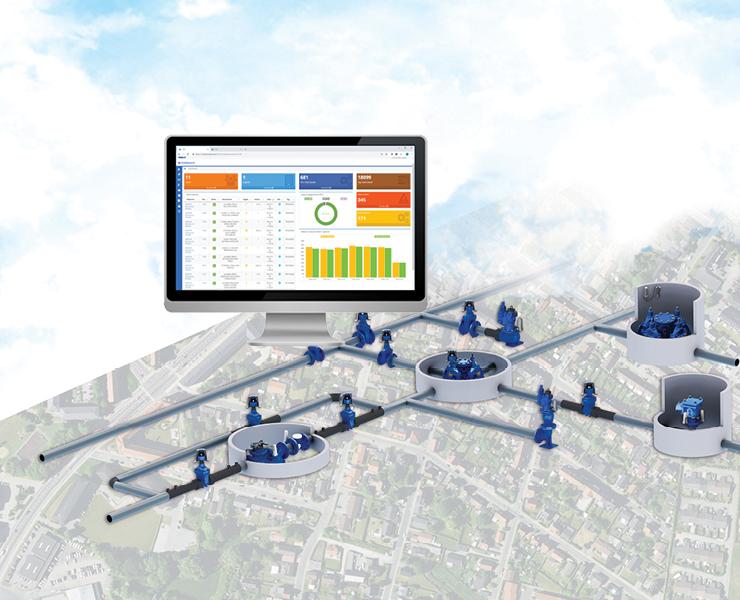
How pressure monitoring revealed hidden network constraints and informed future investment decisions.
Project Overview
When unexplained pressure issues occur within a distribution network, identifying the root cause can be challenging. Without detailed monitoring data, investigations often require extensive fieldwork, network modelling, and time-consuming exploratory activity.
To better understand pressure performance across two priority District Metered Areas (DMAs), United Utilities partnered with AVK to deploy Vidi pressure loggers, enabling continuous pressure monitoring and a clearer understanding of network behaviour.
The objective was simple: determine whether observed pressure reductions were driven by operational demand, network configuration, or underlying infrastructure constraints and provide a clear evidence base for future decision-making.
The Challenge
Water networks are dynamic and complex systems. Ageing infrastructure, changing demand patterns and physical network restrictions can all influence pressure performance and customer service levels.
United Utilities had identified pressure-related concerns within two operational zones and required greater visibility across the network to understand:
- Where pressure losses were occurring
- The scale of those losses
- Whether physical restrictions were contributing to reduced performance
- Which areas should be prioritised for further investigation
The monitored areas served approximately 5,000 customers, making network resilience and service reliability a key operational priority.
AVK’s Solution
AVK deployed Vidi pressure loggers at strategic locations throughout both DMAs, providing continuous pressure monitoring and enabling engineers to assess network performance in far greater detail than was previously possible.
The deployment allowed United Utilities to:
- Quantify pressure losses across the network
- Identify previously unconfirmed restrictions and pinch points
- Compare pressure performance at multiple locations simultaneously
- Build a robust evidence base for future investigations
- Prioritise targeted interventions based on measured network behaviour
The loggers were retrospectively fitted to existing underground hydrants, allowing monitoring to be established with minimal disruption.
Key Findings
The monitoring programme confirmed that both zones were experiencing pressure losses linked to network constraints and topology effects.
Analysis identified:
- Significant pressure losses occurring between key network locations
- Additional localised restrictions that had not previously been quantified
- Variations in network performance driven by elevation differences and hydraulic conditions
- Opportunities for targeted network improvements to improve downstream pressure performance
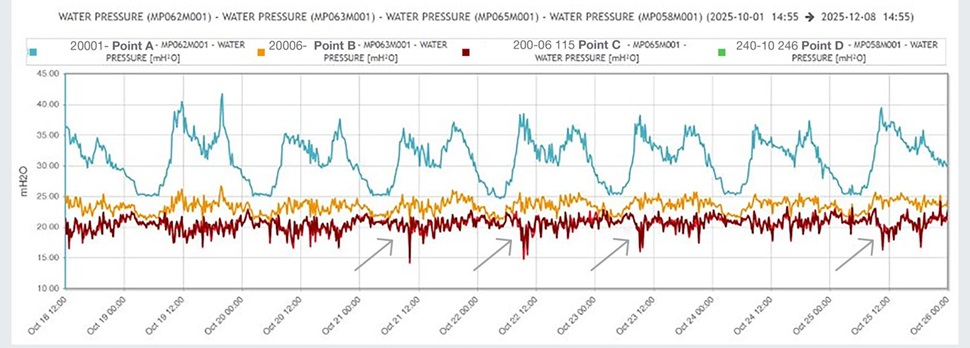
- In zone one, pressure losses of up to 12 metres were observed between the network inlet and downstream monitoring locations, with further losses identified across the wider DMA.
The following graphs show examples of the head losses observed in these DMAs
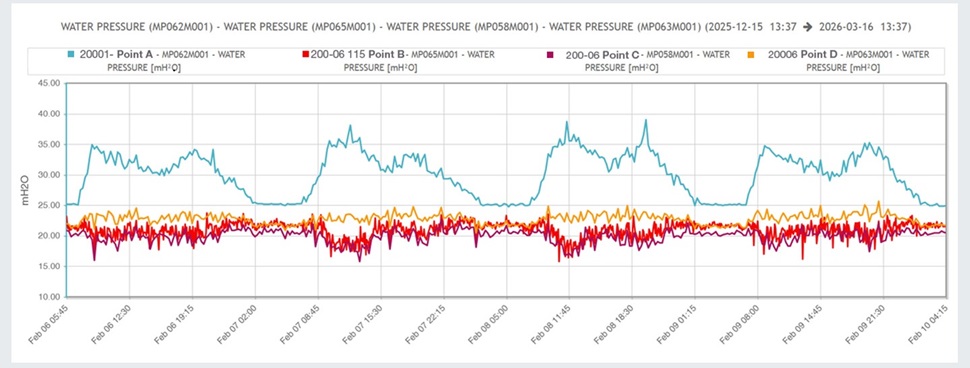
Ist Image above:The PRV controller compensating for up to 12m of head losses between the inlet to the DMA (Point A Blue) and the next logged point (Point D Orange) above.
2nd Image above: A further 6-7m of head loss is apparent from (Point B Orange) until the next logged point (Point D Crimson) (above) – Point C Orange until Point A Crimson (below)
More graphs can be seen on the downable PDF about this case study - see link at the bottom of the page.
These findings validated existing operational concerns while providing greater clarity on the scale and location of the underlying issues.
Turning Data into Action
The value of the trial extended beyond identifying pressure losses.
By providing clear, measurable evidence of network performance, the monitoring programme helped United Utilities move from assumption to informed decision-making.
The data is now supporting:
- Prioritisation of future investigations
- Development of targeted remediation plans
- Assessment of potential network enhancements
- Optimisation of pressure management strategies
- Future investment planning based on measured operational evidence
The findings also identified opportunities to explore alternative network configurations that could help improve pressure performance and reduce the need for compensatory pressure management elsewhere in the system.
Operational Benefits
With access to continuous pressure data, United Utilities can now:
- Focus resources on confirmed problem areas
- Reduce reliance on exploratory investigations
- Improve understanding of network behaviour
- Support investment decisions with operational evidence
- Build a stronger foundation for future network resilience programmes
The trial also demonstrated the wider value of continuous monitoring as part of a proactive approach to DMA performance management.
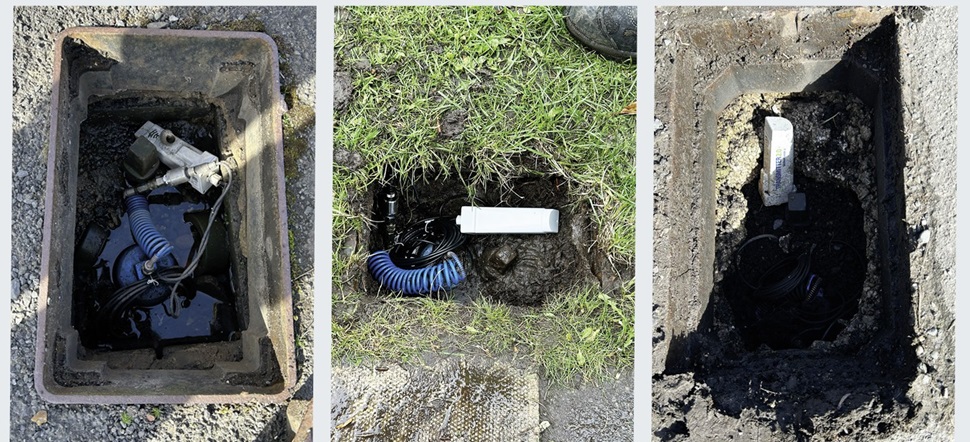
Image above shows the various pressure logger installations.
Customer Feedback
“Thank you for all your help and valuable input throughout the logging activity and data review. The Vidi trial delivered the evidence and network insight we needed to validate the issue, identify additional areas of pressure loss, and support future investment discussions. AVK’s involvement added real value throughout the programme.”
JACK LYON
Water Network Manager, United Utilities
Why It Matters
For water companies, understanding where and why pressure losses occur is essential for improving service, reducing operational inefficiencies, and targeting investment effectively.
This project demonstrates how pressure data and monitoring can help utilities:
- Detect hidden network constraints
- Validate operational assumptions
- Prioritise interventions with confidence
- Support data-driven investment decisions
- Improve long-term network performance and resilience
Conclusion
The Vidi Pressure Trial provided United Utilities with a clearer understanding of network performance across two operational zones, identifying significant pressure constraints and highlighting opportunities for future improvement.
By combining continuous monitoring with detailed data analysis, AVK helped transform network observations into actionable insight, enabling more informed operational planning and supporting the next phase of investigation and network optimisation.
The project highlights how targeted monitoring can deliver far more than data alone, providing the evidence utilities need to make confident decisions, prioritise investment and improve network performance over the long term.